The soft rock music playing is a relief, filling the silence in the car on the way back. It feels like we’re both running on low battery, neither wanting to admit it. At home, I collapse onto my back patio, the day’s near-disaster at the falls a dull ache in my muscles. Even Jeff’s insistence on buying me “darn tough socks” from an outdoor store afterward—an oddly sweet gesture—can’t erase the tremor I still feel.
I scroll through photos from the hike and land on one of me mid-bite into that foul Rx Bar, my face a mask of deranged disgust. A laugh escapes me, sharp and loud in the quiet yard. It’s real. For a moment, I feel lighter.
“Thank you for a wonderful day,” I text Jeff. “And thanks for my coffee! Can’t wait to try it tomorrow morning.”
He’d brought me coffee beans from Spain, a souvenir from his last trip, knowing how obsessed I am with grinding my own. The thoughtfulness softens me, even as I try to stay on guard. I want to believe people can surprise me for the better, and maybe that’s enough for now.
Jeff responds within minutes. “Really was a fun day! Thank you. You want to go out for dinner? Melissa is home and I don’t want to be.”
We had just spent hours together, and now he wants to extend it into the night. My stomach knots in a familiar way, the way it does when someone’s motives are blurred. I think about what he told me earlier: that he hates pressure, tension, confrontation. He wants everything to be easy, light, simple. Meanwhile, I’m no stranger to the art of avoidance myself, but at least I can name it. I can see the patterns playing out in real time, even if I can’t always stop them.
Though my marriage with Reginald is polite, we still share a house and co-parent. It’s not ideal, but it’s honest. I can’t say the same for Jeff, wondering if he’s ever actually sat in his pain, or if he simply jumps from one distraction to the next, filling the silence with another new experience.
“The boys are making dinner,” I text back. “It’s nice outside. A good excuse to sit in your backyard for a while.”
“I suppose I’ll need to be an adult tonight. I’d rather goof off!” his reply comes seconds later.
How much goofing off does a grown man need? He’s allergic to stillness. I would know; I recognize the pattern. Avoidant versus anxious. Part of me runs from connection, craving solitude, while another part aches for someone to truly see me. I live in a state of constant push and pull, wanting to be held and wanting to be free, all at once.
“Be an adult,” I tell him. “I’m doing the laundry. That’s me adulting.”
He replies, “I’m probably pushing it too much, but I could hang out tomorrow night. After that, I get into busy travel time. Something simple—yoga, a walk, a quick bite to eat. Let me know.”
Maybe he’s the anxious one, desperate for connection, comfort, care. He seems to crave it all, and I can’t decide if I’m being judgmental or just observant. Maybe I’m just tired of men who can’t sit with themselves.
Truthfully, I’m not above the craving either. I want someone to show up, to remember the little things, to see me. But I’m trying to learn to want without clinging, to let moments be enough without needing them to mean everything. Maybe that’s the trick: learning to receive without collapsing into dependence.
I write, “How about yoga and a walk at Pine Moore Park tomorrow midmorning or afternoon?”
“Sounds good!” he shoots back. “I’ll wear comfy clothes this time and we can actually do yoga as opposed to the goofing off I did last time!”
I scrunch my nose at the “goofing off” bit. He’s a child in the body of a man. I feel the urge to laugh, then the urge to cry, then the urge to scold myself for being so critical. I’m doing it again—analyzing, dissecting, holding everything up to the light until it loses its shape.
But maybe there’s room for lightness. Maybe “having fun” isn’t a crime. Maybe after decades of carrying everyone else’s burdens, I could learn to set them down, even if only for an afternoon.
Jeff just wants to have fun, and somewhere in the quiet, I realize I do too. We agreed to be friends, and maybe this is what friendship looks like now: not codependence or avoidance, but being present, together, for as long as it feels good.
**
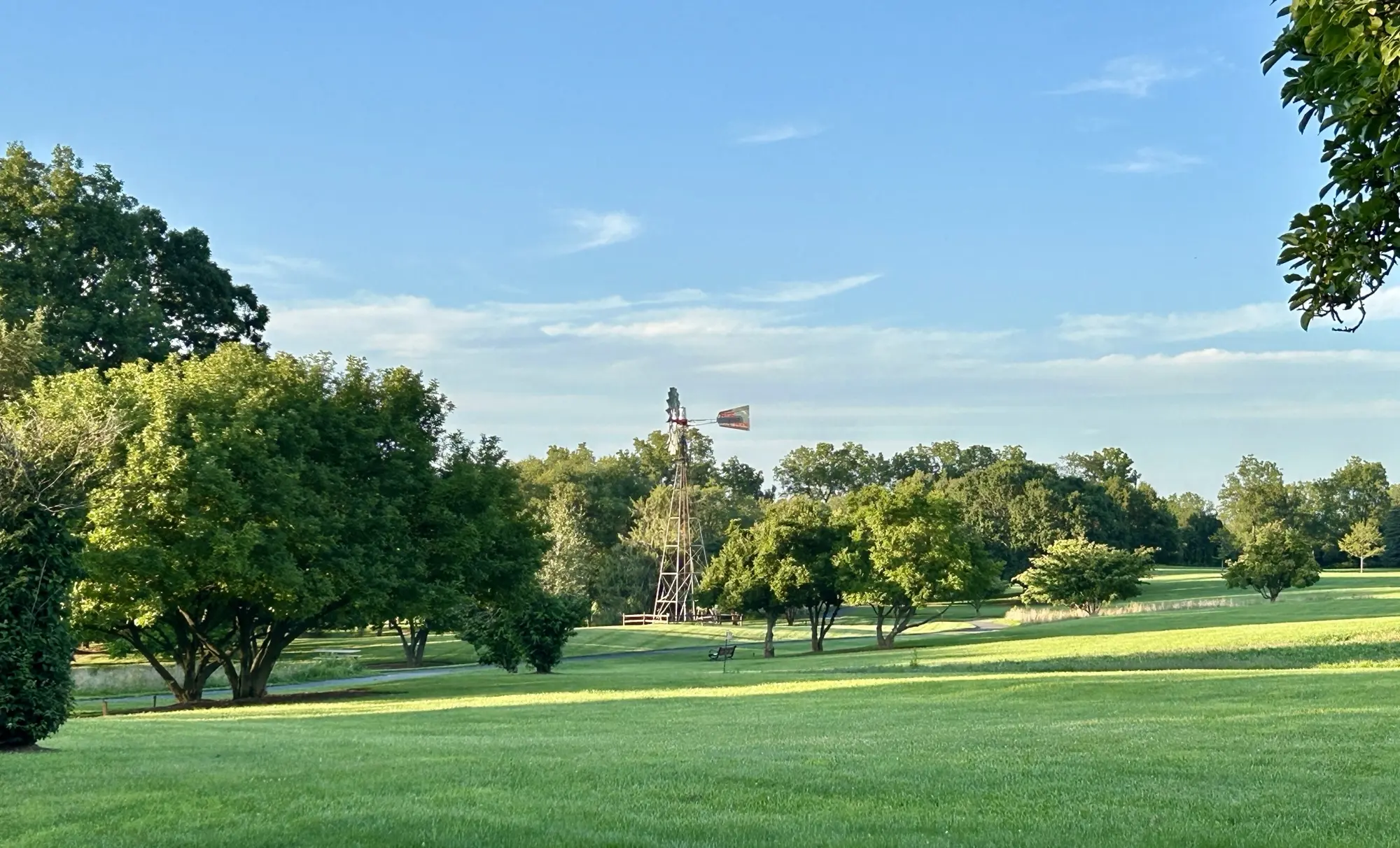
The windmill catches my eye first, always does, standing sentinel over Pine Moore Park like some quiet promise. I love this place. The multi-loop trail, the open field, the little pond that catches the light just so. Today the grass seems greener, or maybe I’m just seeing things differently. My yoga mat harness digs into my shoulder as Jeff and I cross the field, our steps falling into an easy rhythm that surprises me.
True to his word, Jeff wears loose athletic shorts, already rolling out his mat with the enthusiasm of a kid on Christmas morning. I lay mine down a few feet away, close enough to share the space, far enough to breathe. He volunteers his favorite yoga video, and I oblige, though part of me wonders what it means that I’m letting him lead this too.
But then the world softens. The instructor’s voice washes over me — calm, measured, kind — and I feel something in my chest unclench. Birdsong replaces the chaos in my head. The breeze brushes my skin like an apology for all the days I’ve spent indoors, wound tight, waiting for something to go wrong. Freshly cut grass. Sunlight. For twenty minutes, I stop waiting.
Jeff doesn’t laugh once. Not a snicker, not a whispered joke. When the instructor bows with “Namaste,” I breathe the word out and feel my chest tighten again: not from peace, but from the memory. He’d googled that word when we first discussed yoga, didn’t know it then. Yet this is his favorite video? The inconsistency pricks at me, small and sharp as a splinter. I brush it off. Not today. My mind files it away with all the other notes I’ve been taking, the little discrepancies stacking up.
“That was nice,” Jeff says, rolling his mat. “I feel so much better after stretching.”
“You did good. Held the poses.” I roll mine too, slower, buying time. “And you didn’t laugh. Even better.”
He grins, sheepish. “I was holding it in. My inner eight-year-old wanted to comment on every wasp hive in the pavilion roof.” He points up, and I follow his finger to the papery nests tucked in the corners. ADHD, he says, as an excuse, yet what I hear are distractions over discipline. I noticed them too, but chose the instructor’s voice instead.
“Let’s lie out on the grass for a while before we walk,” Jeff suggests, grabbing his mat and sneakers. “I’d like to read something to you. Pick your brain. Know what you think of it.”
The invitation hangs in the air, simple enough on the surface, but I feel the weight of it. Another layer is being added, another step toward something I’m not sure of. Still, curiosity pulls at me. What could he want to share?
“Alright. Over there.” I point to an area near the pavilion, and we carry our mats to the spot. He lays his down. I roll out mine. Then he’s sliding them together, close enough that our shoulders might touch, and my skin prickles with the anticipation of it.
He’s smiling like a little kid, digging into his daypack and retrieving a leather-bound journal. After flipping through the pages, his thumb lands on one halfway filled with scribble.
“Do you have your Bible app on your phone?” he inquires, his finger marking the page.
I swipe open my phone. “What do you want me to search?”
He requests, “James 1:2-4. NLT version. I like it better.”
Mine’s set to NIV. I don’t think it matters, but I appease him, switch it, and type the reference.
“Will you please read it for us?” he asks.
The request lands somewhere between sweet and loaded. I feel it in my body first: a familiar tightness between my chest and stomach, the old warning system kicking in. Bible class. The phone in my hand feels heavy as a ruler against my palm. A ghost of shame rises—the echo of a nun’s voice teaching me that questioning was a sin, and my voice was just noise.
I take a breath and read aloud: “Dear brothers and sisters, when troubles of any kind come your way, consider it an opportunity for great joy. For you know that when your faith is tested, your endurance has a chance to grow. So let it grow, for when your endurance is fully developed, you will be perfect and complete, needing nothing.”
The words settle. Not so bad, actually. I find myself speaking into them, testing their weight. “God’s always testing me. Testing my faith, putting me through hardship. I’ve learned. I endured.” Maybe I’m not overreacting. Maybe I’m just careful. The nun’s face flickers and fades.
“I like how you just broke it down and made it about you.” Jeff replies, head tilted as if he’s absorbing every word. “I love unpacking this stuff. Deep discussions I couldn’t have with Melissa.”
The longing in his voice mirrors my own. Reginald and I used to talk like this: values, goals, dreams, the future we were building. Until our differences became battlegrounds, our debates became competitions, our apologies became performances. Neither willing to bend. Both determined to win.
“I get it. We stopped communicating,” I say, meaning Reginald, meaning me, meaning the way love calcifies when no one’s watching. “I miss having someone to talk to like this.”
I look at Jeff, and his blue eyes catch the sunlight, bright and searching. It’s too much, too soon. I look away, scroll to the next verses: “If you need wisdom, ask our generous God, and he will give it to you. He will not rebuke you for asking. But when you ask him, be sure that your faith is in God alone.”
Silently, I ask God. Am I safe here? Can I be real with him? Can I share the parts of me I’ve learned to hide?
Jeff lies on his stomach, writing in his journal. I watch his pen move, then let my gaze drift. In the distance, two horses appear, moving slowly across the field. A young girl rides the white one, a woman leads the brown one; their progress steady and deliberate.
“Look,” I whisper. “Horses.”
“No way!” Jeff sits up, eyes wide. “That’s so cool.”
We watch them pass—the easy power in their stride, the girl’s faint laughter on the breeze. My mind, desperate for a sign, latches onto the image. It wants to call this permission, a message telling me it’s safe to proceed. It wants to believe.
But fear doesn’t dissolve that easily. My writing has always been the most private part of me, and Reginald taught me what happens when you hand someone your heart and they use it as leverage. Encouragement became discouragement. Approval became disapproval. Love became hurt.
Jeff isn’t Reginald. I say it like a mantra, testing its truth.
“I want to share something with you.” The words come out quiet, trembling. “It’s sort of personal…”
Then I’m speaking—really speaking. “I have these stories,” I hear myself say, “characters just waiting in my head.” I tell him about the novels I abandoned because I couldn’t feel my own emotions enough to give them life. Talk about the long disconnection, the years of just going through the motions. “I lost my way for a while,” I admit, the words fragile in the open air. “But I feel like I’m ready now. The time feels right.”
He listens. Really listens. Lies beside me, attentive, his enthusiasm genuine and unguarded. He wants to read my work. I tell him another time, when I’m ready, and the smile that spreads across my face surprises me. It’s been so long since I felt this relief, yes, but something deeper. Redemption, maybe. The possibility that I can be fully seen and still be safe.
Take up space without shrinking. Stop hiding. Be heard. It all feels so good I almost don’t trust it.
“Thank you for sharing that,” Jeff murmurs softly. “I feel closer to you.”
Not long after, Jeff talks about how he wants to shed his old life, all the clutter and material things, and replace it with something lighter that fits into a small, towable camper. A goal to see every state park, to cross all fifty states before he turns fifty. His eyes flash with the same brightness as the windmill’s blades when he shows me photos of the camper’s interior, eager for my opinion.
“Very ambitious,” I say, flipping through the images. “That’s a huge goal to accomplish.”
He smiles wide and leans in, as if he’s found a secret portal to happiness. “Small, light, simple, and fun. I’d like to explore the state parks and have a place to sleep that is off the ground.” Then he swipes to a second model, almost identical. “It’s a whole new world for me, and thinking about the possibilities is fun.”
I pass back his phone and watch the windmill across the field, its blades catching the sun and reflecting it in a steady, hypnotic rhythm. There’s something soothing about its persistent spinning, its harmonious partnership with the elements. I envy its purpose. I envy its adaptability.
Jeff’s next topic change lands like a cold front. Relationships. The possibility of remarrying. Even as I keep my gaze on the windmill, my body tenses, and I can feel the shift in the air before he even finishes his sentence.
“I want to remarry,” he says, like he’s ordering dessert. “When I get my second wife, I know I can be a better husband with all that I’m learning to grow.”
It’s the “when I get my second wife” that hits a sour note. There’s an entitlement to it, as if wives are a commodity, as if he’s shopping for an upgrade. I want to hit him with the phone. Or maybe just laugh until he hears how ridiculous it sounds. Instead, I just sit with it, feeling the sharp poke of irritation under my ribs.
Jeff keeps talking. I listen, but only partially. The other part of me has recoiled, gone inward, picking at the scab of resentment forming over old wounds. When you can’t even get yourself. The words almost slip out, but I bite down hard on them, letting the silence stretch.
Don’t jump into a relationship out of fear of being alone, I want to say. His talk of “learning to grow” rings hollow, a slogan without substance. I hear no real accountability, no insight into his part in the failure, just a desire for commitment without doing the work. I bite my tongue, letting the silence stretch between us.
Every time Jeff says things like, “It’s so easy to talk to you. I feel safe with you,” I wonder if he even knows what those words mean. Or if he just likes the way they sound. He talks about connection and deep discussions. I catalog every phrase he’s used—safety, stability, care, connection, vulnerability, transparency. It’s a compelling list, but it feels like a performance. A kind, eager, even well-intentioned performance.
I hear the words, yet his actions don’t match. What I hear is an eagerness to skip the messy middle: the slow, ugly, daily work of actually learning and changing.
Of course, I understand. Who wouldn’t want to be chosen, to be someone’s safe place? But I’ve done enough inner work to know that healing is not a destination. It’s a practice.
Jeff wants to be fixed and done, to skip the process and collect the prize. But I know healing isn’t a prize to be won. It’s the daily work of unlearning how to shrink for a man. It’s peeling back layers of old trauma and fighting ghosts in the middle of the night with the old shame curling in my gut. The process is the only thing that lasts, and it’s a process I’m still very much in.
“What do you think?” He turns to me, earnest, hopeful. “Would you ever remarry?”
I think he needs Jesus.
What I really want to say is, I hope you find what you’re looking for. Though I hope you don’t drag anyone else through your unfinished business in the meantime. Instead, I just let the question hang, heavy and awkward.
He waits, watching me. I picture the years of my marriage—Reginald’s betrayal and disinterest, the endless cycles of hope and disappointment, the way I shrank until I was barely visible. I remember his broken promises and the promises I made to myself. Never again. Never settle. Never disappear for someone else’s comfort.
“No. Not at this time of my life,” I answer, scrunching my nose. “It’s like—I’ve been there and done that.” I take a breath, and add, “If God blesses me with a real partner, not just a man who’s taking on the role of a husband, but someone who’s honest, loyal, respectful, and treats me as an equal, then maybe I’ll consider it. I’m focusing on myself for now.”
Even the “maybe” is a stretch, but it’s the truth. Because my feelings are like tides, returning again and again, no matter how many times I try to sweep them out to sea.
There are still so many things I haven’t processed. Grief still comes in silent waves, so thick I have to sit down to keep from being swept away. That’s the real work, the heavy lifting of carrying the past across the room and setting it down, even for an hour.
Just to feel it, to name it, to let it go for a moment. Some days, I can’t even manage that. And right now, I’m just so tired.
This post is part of a fictionalized memoir. The emotional experiences and themes are drawn from my life, but all names, identities, timelines, and circumstances have been altered, obscured, or combined to protect privacy — including my own. These writings are not meant to diagnose, label, or describe any real person. Instead, they illuminate relational patterns that can occur in emotionally imbalanced or narcissistic dynamics. Any resemblance to actual individuals is coincidental or intentionally obscured. The intention is healing and awareness, not identification. These posts are for storytelling purposes only and do not constitute professional advice.
The images woven through My Journey and The Lessons are my own photographs — moments I captured on trails, in forests, beside rivers, and under open sky. They are pieces of my story and are not to be copied or used without permission.


Leave a Reply