“For your enjoyment.” Jeff’s text arrives with a video of him rappelling off a cliff, the camera jostling wildly before he slides down the sandstone face with a surprised hoot. “Here’s where I slid. Was fun regardless.”
Utah’s red rocks and blue sky fill the frame. His laughter echoes from the phone as I watch on my break, another update from his world of canyons and impossible overlooks. This has become our rhythm: a good morning text before my coffee, a photo of a sunrise just as I’m starting my day. He’s determined to be the first thing I think of, and though I tell myself it’s a habit, I’m always hungry for the next message.
He got a permit for Angel’s Landing but skipped it, claiming the heights were too much for him. Instead, he contented himself with other trails, sending me images of vast, empty vistas. I replay the video, snorting at his clumsy recovery. He slid, hooted, and called it fun regardless. He didn’t care about the landing. For a moment, I imagine it—being there, falling, and feeling nothing but the thrill of the descent, the freedom of not caring who was watching.
I text him back. “You just gave me the blessing you wanted to be for me. This made me laugh. So thank you for making me smile.”
He answers instantly, “Silly mistake now that I have a little idea of how to rappel.”
“You recovered from it well,” I write, my thumbs tapping the screen. “Rappelling looks like fun. The climbing looked harder.”
“Just getting to the airport.” He writes a few hours later. “A bit tired and a fairly long day ahead, but the trip was A+. I miss holding you. Wish I could hug you right now.”
He’ll be home tonight. No plans made—he needs to rest, see his kids. I tell myself to be patient, to let him come to me. But my phone feels heavy in my hand, and a low hum starts up under my skin, an ache that has nothing to do with patience.
“Have you ever heard of a sniff kiss?” I type, thinking of my childhood, of the way my mother would press her nose to my cheek and inhale as if gathering my scent like a blessing.
“Nope,” he shoots back. “I’m intrigued. What is it?”
“It’s weird to explain. I’d have to demonstrate one,” I reply, letting the tease dangle.
“Why only one???”
“It depends on if you like it,” I reply, and my face warms at the thought of showing him, of letting intimacy be as simple as breath.
“What are your plans for relaxing today?” he asks. The question startles me; no one ever asks what I need, only what I can do for them. “Rest,” I type back. “Physically and mentally. Read my book, sit outside, and enjoy the peace.”
His reply is instant. “That makes me happy. Be 100% intentional with it.”
Intentional. The word lingers, vibrating with all the ways Jeff tries to curate his life: the meal plans, the workouts, the daily devotionals, the way he schedules his happiness as if it’s a meeting not to be missed. He calls these things “life-giving,” but sometimes it feels more like survival, a performance of joy rather than the real thing.
I remember him confessing how he feels torn, how the practical man he’s always been is at war with a new part that wants to over-correct. He’d spoken of obligations and hard work conflicting with his desire to be free, to travel and go mountain biking, to always be in motion.
We’ve talked about needs versus wants, about how biking makes him feel alive in a way nothing else does. “Do what you love, live the life you want to live because it’s not just our life that’s precious, it’s also our time,” I told him, surprised at my certainty.
He thanked me, as if I was giving him permission to chase his joy. But what did he want from me? What role was I supposed to play in his careful choreography of fulfillment?
Does he want a partner, or just an audience for his performance of joy? Am I another “life-giving” habit he’s trying on, one he’ll discard when the newness fades? The doubt clings like silt. I rewatch the video, and this time I see it: the quick glance to the camera at the end, a check for someone to witness his triumph. The fun, it seems, only counts if it’s shared.
Later, I sit on the porch with my book, trying to lose myself in the story. But the words blur and scatter, my mind tugged back to the phone, to the idea of intention and what it actually feels like to be chosen, to be truly wanted. I want to believe that Jeff’s messages mean something more than routine, that his “miss holding you” is not just a placeholder for something deeper he can’t name. I want to believe I’m more than a footnote in someone else’s adventure.
The sun sinks lower; the sky ripening to gold. I close my eyes, letting the warmth settle over me. The air is alive with mown grass and the chirr of cicadas. I’m alone, but not lonely. Not today.
The ache in my chest is sharp and clean, something being pared down to the bone. I breathe into it, this wanting, this longing. I name it and let it burn without apology. Maybe this is what it feels like to be alive in my own skin.
*
A text lights up my phone as the sun rises: “Good morning, Wildflower! I slept great. 9 hours and deep sleep. Hopefully, you did the same. I’m free for today.”
The name Wildflower still startles something inside me. It’s a strange thrill, a flutter just beneath my ribs. The bloom of it is instant. A smile on my lips, warmth rising in my cheeks, the memory of his voice saying it. “Good morning, Wayfinder!” I reply. “Wow, 9 hours. I’m lucky if I can get in 6. What would you like to do today?”
I try to keep the tone light, but there’s a question under every question. My eagerness feels sharp, almost frantic. Why this need to be the reason he feels nourished? I remember sending him a link—parks, trails, places to go. A silent plea to choose something gentle and alive. To choose me. I want to be a soft place for him to land, a comfort I’ve never known how to ask for myself.
“Maybe we can go do a nice picnic somewhere,” Jeff writes back. “Take food. A blanket. Hang out and plan events.”
The word “picnic” lands tender as a kiss. My mind races ahead. The sun on our skin, the easy intimacy of eating together, the lazy hours with nothing but air and time. I answer, “Cool idea. Love that plan.”
“We can meet at Wegmans to get food for our picnic. I’m so excited!”
“Me too,” I type, and my fingers drum so fast the words blur. For a moment, I let myself believe I’m the only one he wants to see today. I close my eyes, imagining the touch of his hand on mine, the way laughter sounds when it’s just for us.
The hours until our meeting crawl forward, thick with anticipation while I braid my hair, overthinking every detail. Then, chastise myself for caring so much. But when I see him in the parking lot, all of that dissolves.
He’s leaning against his car, sunglasses perched on his head, arms crossed and smile ready. We shop for food together, trading jokes in the deli aisle, hands grazing as we reach for the same tub of olives. I tease him about his “fruity” seltzer obsession, and he pretends to be offended, but inside, I’m blooming. It feels like we’re rehearsing something real.
He cues up his playlist — 80s love songs, neon-bright and shameless. We sing along, and for a moment, it feels easy. I watch his fingers tap the steering wheel and wonder if his happiness is as effortless as it looks, or if he’s curating this moment, too. The thought is a quiet storm under the music, a desperate plea: I want this to be real.
Jeff tells me he’s never been to Liberty Mill Lake, which surprises me. The area is only a few miles from the trails he’s biked a dozen times. I wonder if he’s telling the truth, or if he just wants to be the first to show me this place. The thought makes me want to laugh, or cry, or both. I want to be the new thing in his life that sticks.
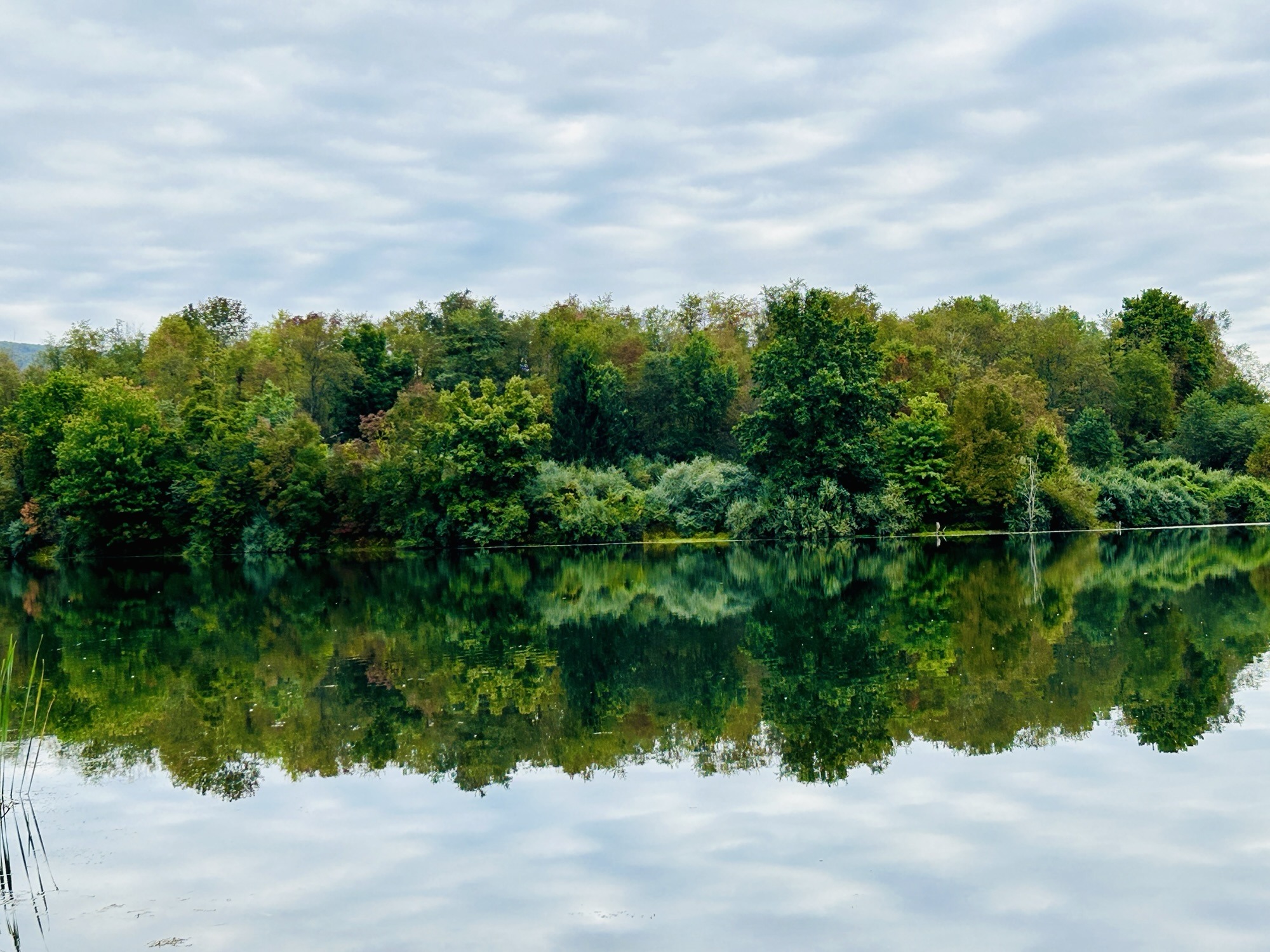
We pull up to the lake, and the world narrows to blue sky, green water, and the hush of Sunday afternoon. We walk the shoreline, his hand at the small of my back when the path narrows. Dragonflies skim the surface, their wings catching sunlight like stained glass.
I lay out my woven mat—a patchwork of blues and reds. It’s the same kind my mother used for picnic lunches back home, and for a second, the memory is so sharp I can almost smell her perfume. He helps me anchor the corners, oblivious, then collapses beside me, shoes off and face turned to the sky. I watch the tension melt from his body, see him become a softer version of himself, and I want to believe I had a part in it.
We unpack our feast—subs, berries, cheeses, the infamous olives, and a rainbow of Bubly cans. He raises his can in a silent toast, and I do the same. We eat, talk, and laugh, the conversation unwinding in easy increments. It’s the kind of happiness that feels almost illicit, as if we’re borrowing time from a future where things actually work out.
After we eat, he leans back and points to a couple paddling a kayak at the far end of the lake. “What’s their story?” he asks, and I know this is his favorite game. I try to play along, spinning stories about retirees and people who rescue stray animals. He laughs at my wildest guesses, then counters with his own. “They’re probably planning their next trip abroad. Or staying local for the grandkids.”
I watch the boat drift, the couple’s silhouettes merging as they glide across the water. I want to believe they’re happy, that they made it to this stage with their love intact. Then I wonder if I’ll ever have that kind of peace—a steady presence, a history built together, a future that isn’t scary or impossible.
Jeff senses my silence. Maybe he always does. He shifts the conversation to his coworker, a woman nearing retirement, healthy and bright but tethered by her husband’s ailments. “She wants to travel,” he states, “but he can barely get out of bed some days. It’s sad.”
I hear the dread in his voice. I know this fear of his: bodies breaking down, time running out, the slow slide into needing help. He’s asked me a dozen times if I think being overweight is a sentence, if I think it’s possible to be both big and well, if it’s really so bad to just want to stay in motion forever. He’s terrified of stillness. I know this because I feel stuck too.
I want to tell him that love can survive bodies changing, that I would never let him rot in a bed alone. But the words catch in my throat, useless against his fear. I just nod, agreeing that his coworker must feel trapped. A familiar ache spreads through my chest—the desperate need to be his exception, to prove that I am the one thing that will last.
He eats another olive and grins at me, oblivious to the ache in my chest. Or maybe he isn’t. Maybe we’re both just pretending it’s not there, that this isn’t the most vulnerable thing either of us has ever done.
There’s a moment where the world is just the two of us and sunlight and the possibility that something good could grow here. I hold on to it as long as I can, memorizing the way it feels to be wanted, seen, and safe. If this is all we ever have, then I want it to be enough.
“There’s a plane overhead,” he says, and I follow his gaze, searching for the glint of metal against the blue. The sky is so bright it hurts, but I keep looking. I know he loves this—tracking the flight paths, wondering where people are going.
“Yes, I see it,” I reply, shading my eyes, but I’m more interested in the eagle circling above us. The sun blanches the clouds, making them look like ocean foam, and I tell him so. “It’s like watching waves instead of clouds.” I point out shapes, a pod of dolphins racing each other, a sea turtle drifting behind. The words tumble out more intimate than intended, as if I’m sharing the secret language of my childhood.
He snorts, “Oh yeah! It really does look like the ocean.” He shifts closer, elbow grazing mine, and points. “See that cluster? It’s half of a whale, and there’s a shark behind it.”
A shark eating a whale. The image is his, but it lands in my gut like a stone. I try to laugh, but the playfulness of the moment is gone, replaced by an icy knot of dread. Why that? Why something so predatory? The breeze shifts, and the idyllic scent of grass and sunscreen feels suddenly thin, a layer over something sharp and unsettling. The unease is there, just under the surface, a current pulling me somewhere I don’t want to go.
Jeff pulls me in, heavy arm draped across my hips, his palm warm and anchoring. “This is perfect,” he murmurs, voice thick with contentment. “No stress. Just us.”
His words settle over me like a blanket, but there’s a part of me that can’t believe it. I want it to be true. I want to relax into the afternoon, let myself drift. He sighs, and the sound is so soft and sincere that it cracks me open. His lips brush my cheek, and I feel my breath catch, a small sound escaping before I can stop it.
He notices. “I like when you sigh. Do it again.” The request is so odd, so intimate, that for a second I don’t know what to do. Is it sweet or strange? I oblige, letting the next exhale out slow and shaky. He grins, pulling me tighter, and the tension in my body dissolves into a different kind of ache: longing.
His lips find mine, and the kiss is gentle at first, then greedy, as if he wants to swallow the air between us. My hands tangle in his hair, his beard scratching my skin, and the need in both of us is sudden and intense. Every sensation magnifies: the heat of his chest, the pressure of his thigh, the way he exhales my name into my mouth. I want him, and I want to stop wanting him, both at once. Desire is a current I can’t fight, but I’m always bracing for the undertow.
He presses me back onto the mat, and I go with it until the world tilts and I feel exposed, visible to the sky, to the strangers on the shore, to the part of myself that never really lets go. My heart hammers. It’s too much. I pull away, breath ragged, the taste of him still on my lips.
“People can see us,” I say, voice thin. “Maybe let’s dial it down.” I untangle myself, sitting up quickly. My hands move to smooth my top, a frantic gesture to pull myself back together, to find the solid edges of my body again.
I watch the birds overhead, the dragonfly flirting with the edge of the water. The sound of the lake laps steadily against the rocks, and I try to absorb it, let it slow my pulse. I want to melt back into the moment the way Jeff can, seamless and unburdened. But I know better. The feeling of being both vulnerable and hungry, never just one or the other. The water, the sky, the endless horizon—I want them to quiet me. For now, I let it.
Jeff traces the outline of my upper back tattoo, his fingers featherlight, and the sensation is almost narcotic. “Your tattoo is so cool. I love the music notes,” he says, his voice low, nearly reverent. “I’m thinking about getting another one. Somewhere on my arm, but I haven’t committed to it yet.”
I lean into his touch, letting the warmth anchor me, then shift to face him, my body alert. “Really? What kind of tattoo are you wanting this time?”
He shows me the quote on his phone, the words stark against the screen: “Everyone must choose one of the two pains: the pain of discipline or the pain of regret.” The words hang between us. “I’m trying to live by that,” he claims. “Work through the pain now, instead of having more regrets.” He talks about wanting a camper but struggling with the cost, the justification. “I have an addictive personality,” he admits, his gaze fixed on the screen. “That’s why I don’t drink. Discipline is how I handle… sinful desires.”
The way he states “sinful desires” vibrates through me. A chill crawls over my skin, and for a moment, I can’t tell if it’s attraction or warning. I want to believe it’s just honesty, but the phrase addictive personality rings out, a warning bell from my past.
I nod, trying to match his vulnerability, but inside, I’m already analyzing—needs versus wants, indulgence versus investment. The discipline to starve a part of yourself so another can grow. I tell him that, parroting back the logic I use on myself: how you have to recognize the impulse for what it is, then choose what actually brings you joy, rather than just momentary relief.
But his quote has already found a fissure in my armor. I feel it in my solar plexus, a sudden ache that’s half-memory, half-forecast. I’ve been living with the pain of regret for a long time. The regret of not listening to my gut, of letting patterns run my life on autopilot. Shrinking for decades so others could expand. Not leaving sooner, or of leaving at all. My children’s wounds, even the invisible ones. The distance that keeps growing between me and everyone I love, as if we’re all drifting on separate boats in the sea.
The regret of my writing, too. Not the act itself, but the way I’ve abandoned it, left my ideas to rot in some unfinished folder like so many other versions of myself. For years, I framed it as just a hobby, something to fill the cracks of motherhood and marriage, but it always represented far more. It was supposed to be the lifeline back to myself. I let the rope slip through my fingers.
“I get what you mean,” I murmur, my voice faint. “For me, it’s the regret of not finishing my book. I started a fictional series years ago, but I couldn’t connect with my characters because I was so disconnected from myself, from my own wounds. Now that I’m learning to feel again, maybe I can actually finish it.”
Jeff studies my face, then smiles, his finger tracing the line of my jaw as if to ground me. “Then do it. Go back to your projects and write.”
His words are simple, but they land with the force of a dare. Do it. I can feel the old spark, the one that used to make my hands itch for a pen, flickering to life. The possibility is terrifying, but I want it bad enough to admit it out loud.
“And I will,” I declare. The words feel reckless, but maybe that’s the discipline I need. The discipline of hope, of trying again, of refusing to let regret be the only legacy I leave myself.
Jeff leans in, dipping his head. “I remember you telling me about sniff kisses. You never demonstrated what a sniff kiss is. Why don’t you show me?” he asks, his voice soft enough that I almost miss it.
My cheeks flush, a sudden warmth rising from my chest. For a second, I’m embarrassed by the intimacy of the request. But I want to be brave, so I laugh and warn him, “This might tickle.”
I move closer, heart thumping, and press my nose and lips to his cheek. His skin is warm, and I inhale him—grass, sunscreen, something familiar I can’t name. My breath fans across his face. When I pull away, he stares at me, blinking in surprise, then laughs, the sound deep and real.
“That was so weird. But I like it. Let me try to do it.”
His version is clumsy and a little too forceful, his nose flattening against my cheek before he sniffs, almost cartoonish. Still, the gesture lands somewhere tender. It makes me giggle, and I realize I haven’t laughed like this—unguarded, without calculation—in weeks.
“Not bad,” I tease. “You could teach a class in sniff kissing.”
He wants to try again, and I let him. We trade sniff kisses, over and over, until our faces are red and our ribs ache. Each time, it’s a little less awkward and a little more real. We laugh, a helpless sound that seems to release all the fear and hope I can’t speak aloud. In these tiny collisions of skin and breath, I feel something uncoil inside me, something that has been bracing for disappointment and, for once, finds none.
When the laughter dies down, I rest my head on his shoulder and close my eyes. Maybe there’s a kind of grace in letting myself admit what I want. A second chance to find joy. Or the freedom, just for a moment, to live without borrowing dread from the future.
The afternoon light sharpens, gold and clear, and the surface of the lake glimmers like a held breath. I try to memorize the way the sun feels on my skin, the hush of wind through the pines, the honest ache in my belly from laughing. It feels like peace, but peace with a pulse—fragile, temporary, precious because it’s already slipping away.
Jeff’s arm twitches beneath me. I sense the change before he says a word; his restlessness is a weather pattern, always moving in. “Let’s walk around the lake for a bit?”
I want to stay in the warmth a little longer, but I nod. “Sure.”
We follow the crushed gravel path, our shoes crunching. His energy spikes, and I have to work to match his stride. With each step, the afternoon’s peace seeps away. I feel my shoulders tighten, my body already adapting, bracing for the next shift in his weather.
An elderly woman in neon running shoes breezes past, her greeting bright. Jeff immediately latches on, matching her pace to ask about the trail. I feel a familiar pang, watching his hunger for connection, the way he draws strangers in to fill some hollow space. He volleys questions, and I catch the longing in his voice as he looks for himself in her story of hiking the circuit alone each summer.
After the woman disappears down the bend, Jeff hops over a shallow creek and asks, “Do you think she’s hiking alone because her husband can’t join her anymore?”
I hear the question beneath the question. The way he turns everything into a limit, a loss, a minus sign. It makes my heart pinch. “I think she’s just enjoying the day,” I answer, careful. “She seemed happy.”
He shrugs, kicking a stone off the path. “I dunno. I’m used to doing stuff alone, but sometimes I wish there was someone with me. It’s more fun that way.”
I want to say that solitude can be enough, that sometimes being alone is less lonely than being misunderstood. But I don’t. I just answer, “Yeah. It’s nice to share things.”
The words taste like a lie. Or maybe just a truth I can’t claim yet.
We walk in silence for a bit, and there’s an ache in it, a static that builds with each step. I wonder if he feels it too, or if he’s already searching for something to break it. I sense how badly he wants me to be the solution, the cure, the other half of his solitude. The thought makes me uneasy, as if I’m not a person but a prescription.
He breaks the silence with a sudden burst of energy, taking off down the path. “Race you to the next bend!” he calls back. It’s his way of changing the weather, of forcing the sun back out. I jog after him, heart pounding with more than exertion. When I catch up, he lifts me onto his back, spinning us in wild circles until the world blurs and we collapse onto the grass.
For a second, I let myself believe this is enough. That I am enough.
But the feelings of loneliness replay in my mind. The echo of his need, the echo of mine. I know this wound; I’ve carried it for years. Maybe we’ll just learn to carry it together, sharing the weight and pretending it’s lighter than it is.
At the water’s edge, I crouch and trace the ripples with my finger. The sky above is a flawless blue, but the surface is never still; every gust, every pebble, every passing bird leaves a mark. I see my reflection—fragmented, shifting.
What wounds do I need to release? What hurts are hiding there, in the water that mirrors the sky?
I don’t know the answer, but for now, I leave the question hanging—open, unanswered, alive.
This post is part of a fictionalized memoir. The emotional experiences and themes are drawn from my life, but all names, identities, timelines, and circumstances have been altered, obscured, or combined to protect privacy — including my own. These writings are not meant to diagnose, label, or describe any real person. Instead, they illuminate relational patterns that can occur in emotionally imbalanced or narcissistic dynamics. Any resemblance to actual individuals is coincidental or intentionally obscured. The intention is healing and awareness, not identification. These posts are for storytelling purposes only and do not constitute professional advice.
The images woven through My Journey and The Lessons are my own photographs — moments I captured on trails, in forests, beside rivers, and under open sky. They are pieces of my story and are not to be copied or used without permission.


Leave a Reply